
The Little Pinch That Turns Leggy Basil Into a Bush
 Suzy·Co-founder, NatureTech·Updated Oct 2026·
4 min read
Suzy·Co-founder, NatureTech·Updated Oct 2026·
4 min read
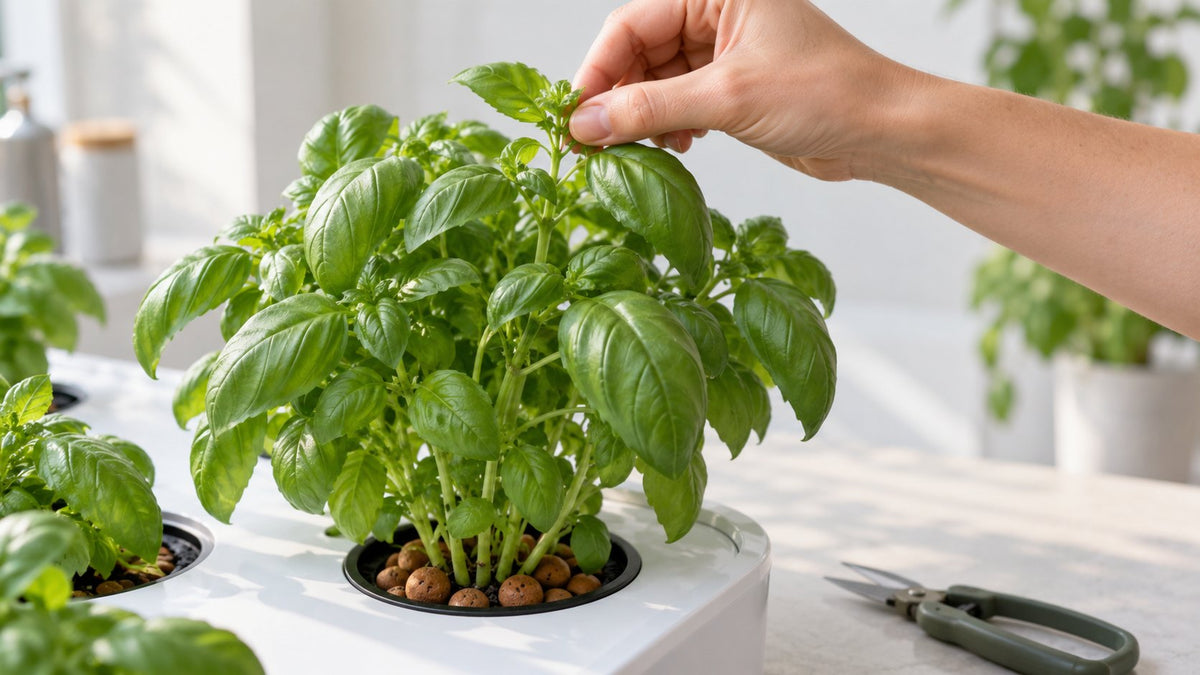
When your basil shoots up tall and thin, it isn't doing anything wrong. It's doing exactly what basil wants to do. Here's how to change its mind.

If you've grown basil for more than a few weeks, you've probably seen it happen. The plant looks wonderful, and then one day it's tall and skinny, with a handful of leaves at the top and a lot of bare stem underneath. Sometimes there's a little flower spike starting at the tip.
That isn't a sign you did something wrong. Left on its own, basil grows up. As far as the plant is concerned, its job is to grow tall and go to seed. Our job, if we want leaves for the kitchen, is to talk it out of that.
The way to do it is surprisingly small. You pinch off the tip.
After more than fifteen years of growing hydroponically, I still think this is one of the simplest habits there is that makes a difference you can actually see.
Why one small pinch gives you a fuller plant
Every point where a pair of leaves meets the stem is called a node. When you remove the growing tip just above a node, the plant stops putting all its energy into height. Instead, two new branches grow out of that node.
One stem becomes two. Pinch those two later and they become four. That's how a single stalk turns into a bush, and more branches means more leaves to harvest.
When to start
Wait until your basil has 3 to 4 sets of true leaves. True leaves are the ones that actually look like basil, not the first little rounded seed leaves. That's your first pinch.
After that, pinch a stem again once it has grown 3 to 4 new pairs of leaves above your last pinch. During active growth that usually comes around every couple of weeks. Basil grows fast in warm weather, though, so it often gets there sooner. Watch the plant, not the calendar, and if you see buds starting to form, pinch right away.

How to do it
- Find the node. Look at the top of a stem and find the topmost set of leaves. Just below it, a smaller pair is usually starting to form. The point where the leaves meet the stem is the node, and your cut goes just above it.
- Pinch just above the node. Nip the tip off cleanly between your thumb and index finger. If a stem is thicker than a matchstick, use clean scissors or herb snips instead. Leave the node and the leaves below it in place. Within a few days you'll see two new shoots starting.
- Use what you pinched. Those little tips are edible. Toss them into whatever you're cooking tonight, or add them to the compost.
That's it. The whole thing takes about five minutes, even with a few plants.


Which herbs like this, and which don't
Pinching works beautifully on basil, mint, oregano and lemon balm.
Thyme and rosemary can be pinched too, but gently. They're woody perennials, so take only the soft green tips and never cut back into old bare wood. Those woody sections usually won't grow back.
A few herbs need a different approach altogether:
- Chives: cut them at the base instead.
- Cilantro, dill and parsley: pick the outer leaves and let the center keep growing.
If you spot flower buds
Pinching regularly is what keeps basil from flowering in the first place. But it happens to all of us. If you find small flower buds at the top of a stem (they look like tightly clustered tiny leaves, or a little spike), cut that stem back to the first healthy leaf node below the bud.
To be clear, this won't make the plant grow more leaves on its own. Think of it as a reset. From here on, pinch a little more often so you stay ahead of the buds.

"My basil is already flowering. Is it too late?"
Not for harvesting. The leaves are still good to eat, though they have less flavor and aroma once the plant flowers. Pulling off the flowers won't bring the leafy growth back, and it can actually encourage more flowers to form where the leaves meet the stem. So pick the leaves you want now, enjoy them, and next time start pinching earlier, before the buds appear.
"My herb is tall and thin. Did I cause this?"
That's what growers call leggy growth. It happens when a plant hasn't been pinched and has put all its energy into height instead of branching. The good news is that it's fixable.
Cut the tallest stems back by about one-third, to a healthy node. New side shoots should appear within a week or two. Just don't cut back all the tall stems at once.
The one rule to remember: never remove more than one-third of the plant in a single session. That goes for catching up after a missed week, too. A little at a time is always kinder to the plant.
A five-minute habit
Pinching isn't a chore. It's one of those small things that quietly changes what you get from your garden. A few minutes every couple of weeks, and your basil stays bushy, full and leafy for as long as it's growing.
Happy growing, and pesto for days!

Suzy brings hands-on experience from commercial hydroponics and years of working with home growers, turning practical lessons into clear guidance for growing food at home.
Grow alongside thousands of others.
New guides before anyone else, seasonal tips timed to your harvest, and member-only content.