
Removing Tomato Suckers the Right Way: Send Your Tomato's Energy Into Fruit
 Suzy·Co-founder, NatureTech·Updated Oct 2026·
6 min read
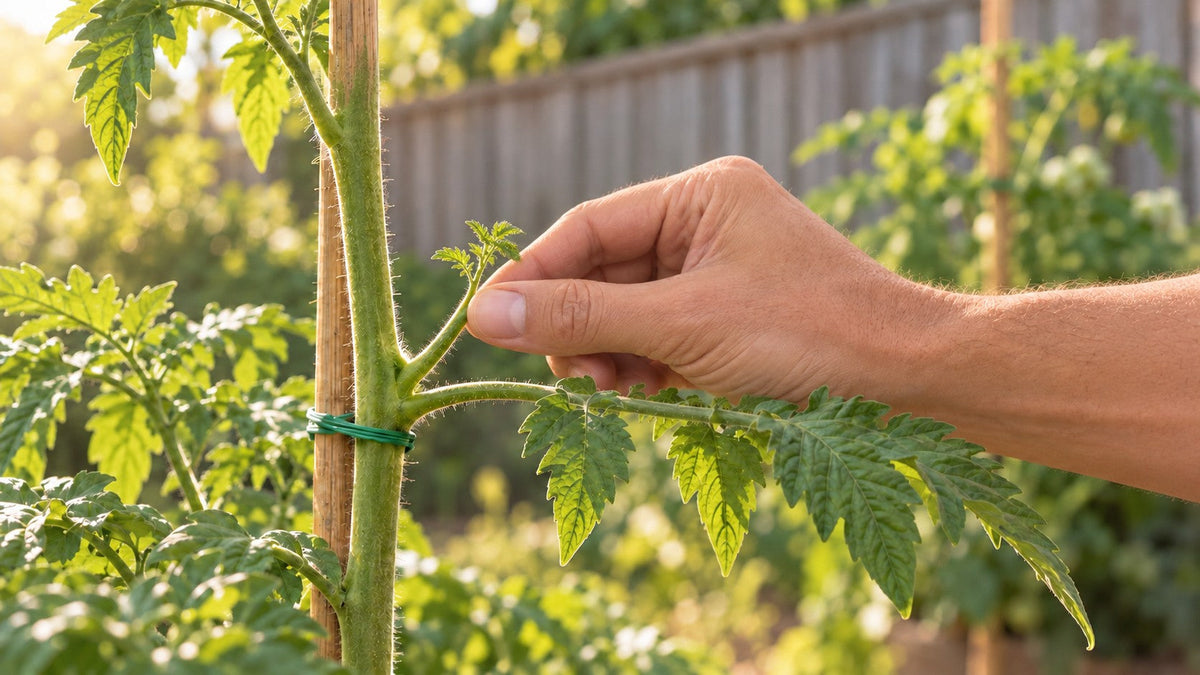
On a vining tomato, suckers are side shoots that grow fast and pull energy away from the fruit. Take them off as they appear, and the plant puts that energy into tomatoes, with a more open plant where problems are easier to spot.

You planted one tomato and gave it a stake. A month later it looks like three plants fighting over the same pole. There are leaves everywhere, stems heading off sideways, and somewhere in the middle of it all a few flowers.
If that sounds like your plant, you haven't done anything wrong. Vining tomatoes grow this way. They simply need a little steering, and in my years of working with home growers, the steering almost always starts with one small thing that hides in plain sight.
What a sucker is
A sucker is a side shoot. It grows in the leaf axil, which is the grower's word for the V between a leaf stem and the main stem. It starts as a tiny tuft of leaves tucked into that corner, pointing out at about 45 degrees. Left alone, it keeps growing fast.

Why it's worth taking them off
On vining tomatoes, suckers grow fast and pull energy away from the fruit. Removing them keeps the plant's effort on the tomatoes you're actually waiting for.
There's a second benefit I appreciate just as much. A plant with fewer crowded stems lets air move through it, and when you can see inside the plant, disease is much easier to spot.
First, check which kind of tomato you have
This is the part people skip, so please don't. Removing suckers is for indeterminate tomatoes, also called vining tomatoes, in any growing system: soil, containers or hydroponics.
Determinate tomatoes, the bush types, are different. They fruit on all their stems, so removing their suckers lowers your harvest.

How do you tell them apart? Indeterminate tomatoes keep growing taller all season and fruit continuously. They need support and grow well past 4 feet (1.2 m). Determinate tomatoes stop at a set height, fruit all at once and stay compact. If the label says "vine" or gives no height limit, it is likely indeterminate. When in doubt, check the variety name.
When to start, and how often
There's no need to wait. Start as soon as you see the first suckers, and check the plant every 7 days from then on. Keep going all season, even once the plant is full of fruit, because new suckers keep forming as it grows.
Stop 2 to 3 weeks before you plan to end the plant's cycle. That way it keeps enough leaves to protect the last fruit.
Pick a time when the leaves are dry, ideally in the morning, so the cuts dry before evening. A wet plant spreads disease more easily.
How to do it
You'll need your fingers, a pair of sterilized pruning snips for the bigger suckers, and some 70% rubbing alcohol with a cloth for wiping the blades between plants.
1. Find all the suckers first
Scan the main stem from the bottom to the top and look into every leaf axil. Find them all before you remove anything, so you have the whole picture.

2. Choose the one sucker to keep
The sucker just below the lowest flower cluster is the strongest. If you have a tall, roomy setup, you can keep it and let it grow into a second main stem for more fruit. If height or spacing is tight, keep the plant to a single stem and remove this one too.

3. Pinch off the small ones
Pinch suckers shorter than 1 inch (2.5 cm) between your thumb and index finger, right against the main stem. Leave no stub behind.

4. Cut the larger ones
For suckers longer than 1 inch (2.5 cm), use sterilized snips. Cut close to the main stem, taking care not to nick it. Wipe the blades with alcohol before you move on to the next plant.

5. Clear them away
Collect every sucker you removed and take it away from the plants. Wash your hands with soap before you work on the next plant.

A little bonus: grow a new plant from a sucker
Here's something I love to share. Tomato suckers root very easily, so the ones you remove don't have to go to waste.
Right after you take a healthy sucker off, put its cut end in a glass of water, or push it into a wet plug of peat, rock wool or any other growing medium. Larger suckers, about 3 to 4 inches (7.5 to 10 cm) long, are the easiest to work with. Keep it in a cool, bright spot. It will grow roots, usually within two to three weeks, and from there you can grow it on as a new tomato plant.
When things don't go to plan
"I missed a week and the suckers are big. Do I take them all off now?"
No. Never remove more than one-third of the plant's green growth at once. Take the largest or most crowded suckers first, and come back in three to four days for the rest.
"The sucker below the first flower cluster got big before I decided what to do with it. Can I still remove it?"
Leave it and train it as a second main stem. At that size, removing it would stress the plant more than keeping it. Tie it to its support and manage it from now on.
"My tomato keeps making suckers near the base of the stem. Is that normal?"
Yes. These are basal suckers, and they appear at the base of the stem, near the soil or growing medium. Remove them the same way as the ones in the leaf axils. They take energy from the plant without producing useful fruit.
A small habit with a big payoff
Once you know what you're looking for, you'll start seeing suckers everywhere, and that's a good thing. Five quiet minutes with your plant once a week is all this takes. You get to know it a little better each time, and it rewards you by putting its energy where you want it.
Enjoy those tomatoes. I hope this is the season your vine finally behaves.

Suzy brings hands-on experience from commercial hydroponics and years of working with home growers, turning practical lessons into clear guidance for growing food at home.
Grow alongside thousands of others.
New guides before anyone else, seasonal tips timed to your harvest, and member-only content.