
Calibrate Your EC Meter in 5 Minutes and Trust Every Reading
 Suzy·Co-founder, NatureTech·Updated Nov 2026·
5 min read
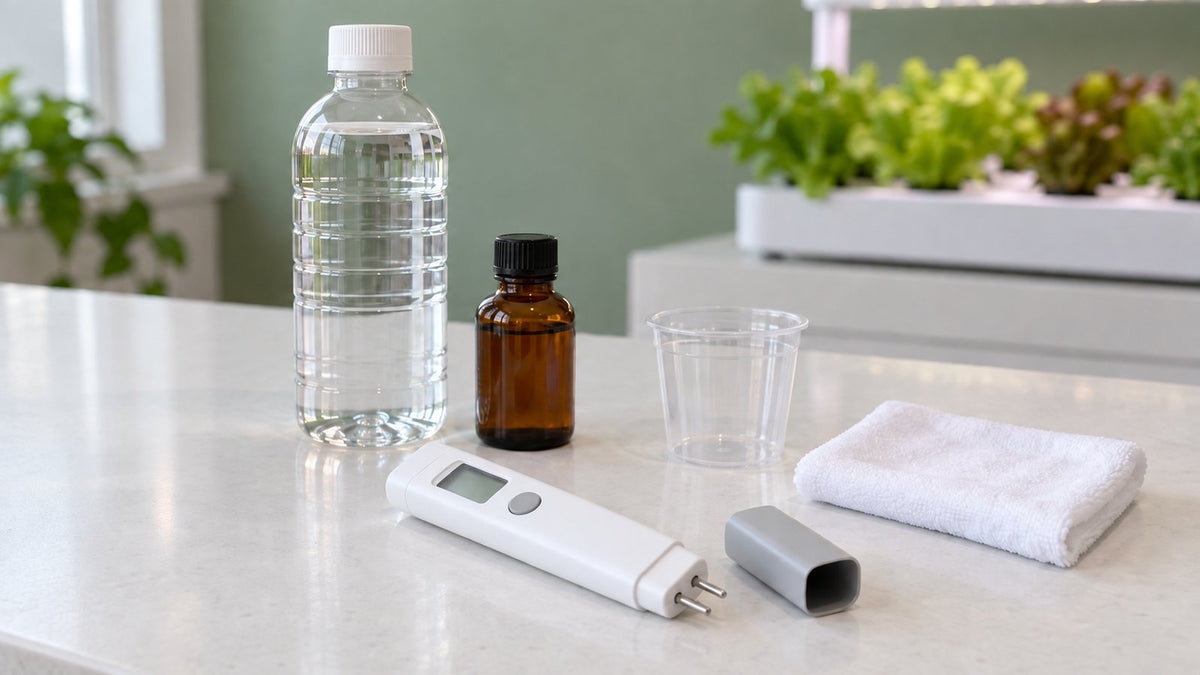
EC meters drift over time, so the numbers you rely on for every top-up and every refresh can quietly become wrong. A five-minute calibration against a known reference solution resets the meter, and every reading after that is one you can trust.
You test your nutrient solution, the number looks fine, and you move on. Then you start to wonder whether the number on the screen is still right.
Sometimes the problem isn't the plants or the nutrients at all. It's the meter. EC and PPM meters drift over time, and the numbers can quietly become wrong. The good news is that this is one of the easiest problems in hydroponics to fix.
What calibration does
EC stands for electrical conductivity. Your meter measures how well the water carries a tiny electric current, and that is the number you use to judge your nutrient solution.
Calibration means putting the meter into a solution whose EC is already known, 1.413 mS/cm, and telling the meter "this is what 1.413 looks like." The meter resets itself against that reference, and every reading you take afterward is measured from a correct starting point.
If your meter shows PPM instead of EC, you calibrate exactly the same way. The meter measures conductivity and converts it to PPM with a built-in factor, so one calibration corrects both displays.
When to calibrate
Watch the meter itself for the signs. Calibrate whenever two back-to-back readings of the same solution give you different numbers. Do it as well if you dropped the meter, changed its battery or left it somewhere hot.
Even if nothing seems off, calibrate every 60 days. The probe ages whether you use it or not, so if you only grow once a year, calibrate at the start of each cycle.
If you also use a digital pH meter, it needs its own calibration, and you can do both on the same day.
How to do it
You'll need your EC or PPM meter, EC calibration solution at 1.413 mS/cm, distilled water, a small cup and a clean cloth. The whole job takes about five minutes.
One habit before you start: keep your fingers off the metal sensing tip of the probe. Skin oils coat the sensor and cause drift, even on a meter you've just calibrated.

1. Set up and rinse the probe
Pour a small amount of calibration solution into your small cup. Rinse the probe under distilled water and shake off the excess gently. Don't wipe the sensor.
Place the probe into the cup, then tap it lightly against the side of the cup to release any air bubbles trapped around the sensor. Wait two to three minutes for the reading to settle.

2. Calibrate and verify
With the probe still in the solution and the reading steady, press and hold the CAL button for three to five seconds. The display confirms the calibration, usually by flashing or by showing the target value. The meter sets itself to 1.413.
Wait a few seconds and check the reading. It should now show between 1.31 and 1.51 mS/cm, which means within 0.1 of 1.413.
Some meters calibrate with a small trimmer screw or through a menu instead of a CAL button. If yours does, follow the instructions for your model.

3. Rinse and store the probe
Rinse the probe under distilled water and shake off the excess gently. Pat the metal contact points dry with a clean cloth, without rubbing them. Put the protective cap back on and store the meter in a dry place at room temperature.
Unlike pH probes, EC probes are meant to be stored dry. What matters is keeping the contact points clean and undisturbed between uses. Pour the used solution away, too.

When things don't go to plan
"My reading won't settle, no matter how long I wait."
There are three common causes. First, the solution may be too cold or too warm. It should be around room temperature, about 77°F (25°C). Second, the probe may have mineral buildup. Rinse it under distilled water, gently scrub the sensing points with a soft brush, rinse again and retry. Third, the probe may have been stored poorly or dropped. If none of that helps, the probe is likely at the end of its life and needs replacing.
"There's calibration solution left in the cup. Can I pour it back or save it for next time?"
No. Calibration solution is designed to be used once and then thrown away. The probe leaves tiny traces of whatever was on it, and that changes the solution's EC enough to throw off the next calibration. Pour only what you need for one use. Once opened, the original bottle stays good for 6 to 12 months if you keep it sealed and cool. Replace it if it looks cloudy or discolored.
"My two meters read the same water and show different PPM numbers."
That's expected. Different PPM meters use different conversion factors, usually 500 or 700, so the same water can show two different PPM numbers. For consistency, switch your display to mS/cm and stay there.
"The store also sells a 2.77 solution. Do I need that one too?"
For home hydroponics, one point at 1.413 mS/cm is enough. Most of your readings will fall between 0.5 and 2.5 mS/cm, and 1.413 sits comfortably in the middle. A second point at 2.77 mS/cm is worth the extra step if you grow in extreme temperatures, run several systems with very different target ranges, or notice your meter is reliable at low readings but drifts at high ones. Otherwise, single-point calibration is the standard.
Five minutes for numbers you can trust
Every decision you make about your nutrient solution starts with a number on that little screen. Calibrating every couple of months is a small habit, and it means that when your meter tells you something, you can believe it and act on it with confidence.
Here's to readings you can take to the bank.
Not sure what your plants need?
Vegardi knows your system, your crops, and your climate, then tells you exactly what to do and when.

Suzy brings hands-on experience from commercial hydroponics and years of working with home growers, turning practical lessons into clear guidance for growing food at home.
Grow this next
Keep growing with us. It's free.
Join the Growers' Club for our best professional growing content, the kind we usually sell, plus first news, gifts and perks only members get.
We couldn't add you just now. Please try again.
One click to unsubscribe. We never share your address.
Almost there.
Check your inbox and confirm your email to join.
One quick question: what matters most to you in a hydroponic system?
We couldn't save that just now. Please try again, or skip.
SkipThank you.
One click in that email and you're in. While you wait:
Explore the Learn library → See the three systems → Wally Smart
 Homie Smart
 Tobato Smart