
A Fresh Reservoir Every Month Keeps Your Plants Fed Right
 Suzy·Co-founder, NatureTech·Updated Nov 2026·
5 min read

Once a month, drain the reservoir, rinse it and mix a new nutrient solution from scratch. Weekly top-ups can't undo the slow drift in the balance between nutrients. A full refresh resets it, so your plants get every nutrient in the proportions the formula was made to deliver.
Your EC and pH are right where they should be, and you've topped up every week like clockwork. So why change all that water?
It's a fair question, and one I hear often.
Why a good reading isn't the whole story
Plants don't take up every nutrient at the same rate. Some elements get used faster than others. Over a month of weekly top-ups, the ratios between the major nutrients and the trace nutrients drift further and further from what the formula was designed to give your plants.
Your EC meter can't see that. It reads the total amount of dissolved salts in the water, but it can't tell you whether each element is there in the right proportion to the others. A healthy EC reading can hide an unbalanced solution.

Draining and starting over resets those ratios.
A weekly top-up adds water and adjusts the same solution, and a flush is a separate fix for a problem, not a routine. The monthly refresh is the one in between: a scheduled fresh start.
When to do it
Your meters won't tell you it's time, and that's exactly why it goes on the calendar. Refresh the reservoir every 30 days, even when the readings look fine. It takes about 15 minutes.
What you'll need
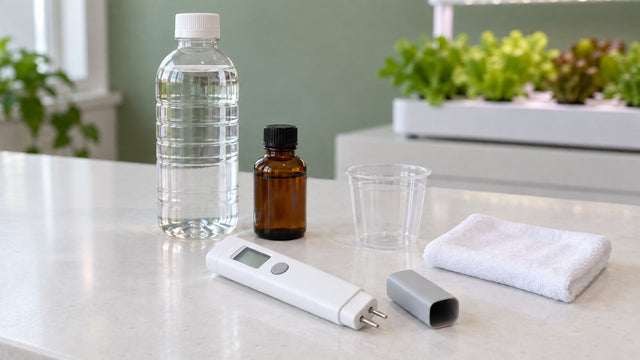
An EC or PPM meter, and a pH meter (I recommend a digital one, though a chemical test kit or test strips also work). Add pH Up, pH Down, fresh water, a measuring cup, a syringe for small doses, a clean cloth for the reservoir walls, and hydroponic nutrients. Those must be made for hydroponics: regular garden fertilizer is not suitable.
How to do it
1. Empty the reservoir completely
First, unplug the system at the wall outlet. If your reservoir has a drain port at the bottom, open it and let the water run out through a hose or into a container. If it doesn't, scoop or siphon out at least half of the water first, then carefully lift or tilt the reservoir to pour out the rest. Once most of it is out, tilt the reservoir slightly to one side to get the last of it.
Be careful with the lifting. A full reservoir is heavy: about 10 gallons (40 L) of water weighs about 88 pounds (40 kg). That is why at least half comes out before you move or tilt it. Keep a firm grip, and work on a stable surface.
The old solution is basically dilute fertilizer water, so you can pour it down the sink, use it on garden plants or your lawn, or add it to compost.

2. Rinse away salt and residue
Rinse the inside of the reservoir with fresh water. If some residue is stuck to the walls, wipe it gently with a clean cloth or a soft sponge. Drain the rinse water the same way you drained the old solution. Skip the soap: this is a refresh, not a deep clean. With the reservoir empty, it's a good day for the pump's monthly clean too.

3. Fill with fresh water
Pour fresh water into the reservoir. If your reservoir has a float valve, stop when the water reaches the float's resting level. If not, fill to the fill line your system's instructions give you.

4. Bring the EC and pH into range
Check the recommended EC or PPM and pH ranges for your plants. Then start with less nutrient than you think you need. Add the concentrate gradually, stirring gently, until the EC reaches the target range. Adding too little is easy to fix. Adding too much means diluting a full reservoir.
Then measure the pH and adjust it with pH Up or pH Down in small amounts until it sits in your target range. Wait a few minutes between adjustments, so the solution mixes and the readings settle.
pH Up and pH Down are a strong base and a strong acid, so handle them with care. Wear gloves and eye protection, add each one to the reservoir water a little at a time, never pour them into each other, and keep the bottles sealed and away from children.

Questions I hear a lot
"My plants are sitting without water while I work. How long do I have?"
In most setups, plants can safely go without flowing water for about an hour in normal conditions, or around 30 minutes on hot days. This matters most in NFT systems and other setups where the roots hang in the air instead of sitting in water or in a growing medium that holds moisture. Those roots dry out fast once the water stops. If the job takes longer than expected, mist the roots with fresh water until the reservoir is back in place. If your system keeps water around the roots, like deep water culture or a system with a growing medium, you have more time, but it's still best to work efficiently.
"The reservoir looks grimy. Should I scrub it with soap?"
Not as part of the monthly refresh. Water, plus a cloth or soft sponge for stubborn spots, is all you need. A deep clean with soap is for the end of a growing cycle, once all the plants are out. If you keep up with your monthly refreshes, the reservoir should stay clean enough that a mid-cycle deep clean is rarely needed.
The exception is a reservoir that's really dirty, with heavy slime, a strong smell or visible contamination. Then you can take it out, wash it with a mild soap and rinse it thoroughly before you put it back. Rinse until every bit of suds is gone, because soap residue can harm your plants.
A fresh start, every month
I think of the monthly refresh as clearing the table before a new meal. Fifteen minutes once a month, and your plants start over with a solution whose nutrients are back in balance with each other.
Here's to a clean slate and a happy, well-fed garden all month long.
Not sure what your plants need?
Vegardi knows your system, your crops, and your climate, then tells you exactly what to do and when.

Suzy brings hands-on experience from commercial hydroponics and years of working with home growers, turning practical lessons into clear guidance for growing food at home.
Grow this next
Keep growing with us. It's free.
Join the Growers' Club for our best professional growing content, the kind we usually sell, plus first news, gifts and perks only members get.
We couldn't add you just now. Please try again.
One click to unsubscribe. We never share your address.
Almost there.
Check your inbox and confirm your email to join.
One quick question: what matters most to you in a hydroponic system?
We couldn't save that just now. Please try again, or skip.
SkipThank you.
One click in that email and you're in. While you wait:
Explore the Learn library → See the three systems → Wally Smart
 Homie Smart
 Tobato Smart