NFT Channels for Hydroponics: How Shape, Size and Access Affect Your Harvest
 Suzy·Published Nov 2026·
12 min read
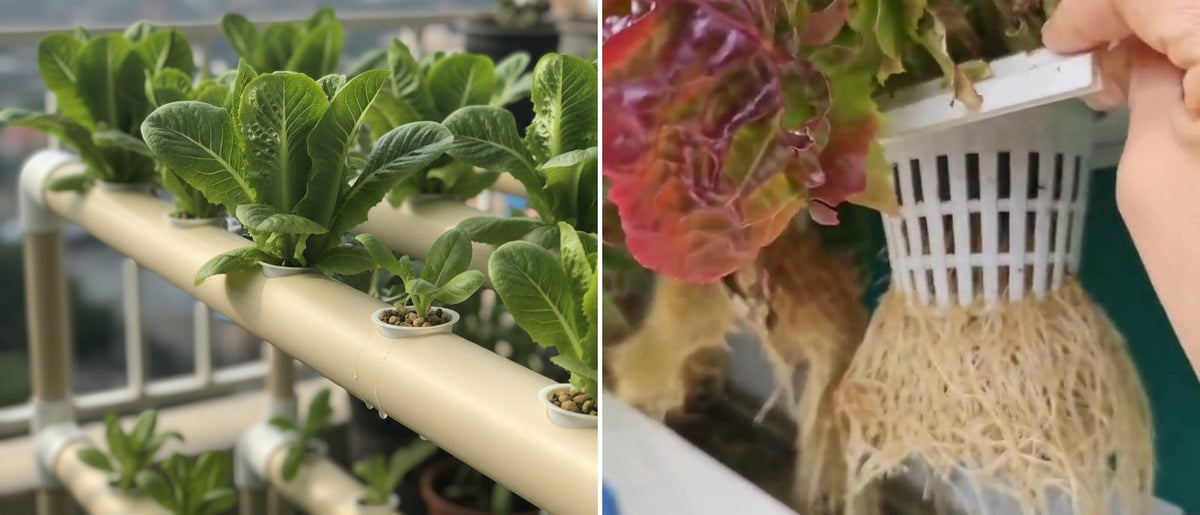
An NFT channel is more than a pipe that holds plants. Its floor decides how the water spreads, its size decides how long roots have room to grow, and its design decides whether you can ever reach those roots again. This guide explains each of those factors, so you can judge a system by the parts that matter most.

How an NFT channel works
NFT stands for nutrient film technique. Plants sit in net cups along the top of a channel, sometimes called a gutter or gully. Vinyl rain gutters, a common DIY option, can be judged by the same criteria: width, floor shape and access. A pump lifts nutrient solution from the tank to the high end of the channel, and it flows down a gentle slope as a thin film before draining back to the tank. Oregon State University Extension recommends a slope of at least 2 percent, about a quarter inch of drop per foot, to keep that film moving.

The roots grow down to the floor of the channel and spread along it. The lower part of the root mass sits in the moving film and takes up water and nutrients. The upper part stays in the humid air above it and takes up oxygen. Nearly everything that happens inside a channel over a season comes back to that balance: water along the floor, air above it, and enough room for both as the roots grow.

That gives every channel three jobs. It has to carry the film evenly. It has to give the roots room for as long as the crop stays in it. And it has to let you maintain the roots and the inside surfaces. Shape, size and access are how a channel does those three jobs.
Does the shape of the channel matter?
Channels are sold in many profiles: round PVC pipes, square and rectangular channels, and channels with a curved floor. All of them can grow healthy plants. What the shape changes is how the film spreads across the floor.
- Round pipe: the water gathers in a narrow strip along the lowest point of the curve. Young roots find it easily. As the root mat grows, it builds up in that narrow strip.
- Curved floor: a channel with a gently curved floor also draws the film toward the center, but over a wider floor than a pipe.
- Flat floor: square and rectangular channels spread the film across the full width, as long as the channel sits level from side to side. A mature root mat can lie flat and wide, with water moving under and through it. Commercial NFT channels are generally flat-bottomed, according to Virginia Cooperative Extension, and some add ribbed or textured floors to keep the film from narrowing into streams.

Shape, then, is less a question of which profile is "best" and more a question of how much usable floor the roots will have once the crop is mature. That leads to size.
What size hydroponic channel do you need?
Roots do not stop growing when the leaves look ready. Over a season they thicken into a mat along the channel floor. If the channel is too small for the crop and the length of time it stays there, the mat eventually fills the cross-section. Flow slows, then backs up behind the roots. The solution starts to escape through planting holes and joints, and plants further down the channel receive less of it.
This limit is well documented. Oregon State University Extension describes NFT channels as offering limited rooting space, best suited to short-lived or small-rooted crops. The authors of the open-access textbook Aquaponics Food Production Systems describe root growth as a major constraint in NFT, one that keeps out crops grown longer than four or five months.
The practical answer comes down to three questions.
- How aggressive are the roots? Some crops build far larger root systems than others. In our experience, tomatoes, luffa and squash are among the most vigorous, while leafy greens and most herbs stay modest.
- How long will the plant stay in the channel? Small channels, including the 2- to 3-inch PVC pipes widely sold for hydroponics, suit crops that stay about a month, after which everything is harvested and replanted. Lettuce does not have to be a one-month crop, though. Picked from the outside in, as in our guide to harvesting leafy greens, it keeps producing for months, and over that time its roots outgrow a small pipe. For comparison, Virginia Cooperative Extension notes that commercial NFT channels are usually about 4 inches wide and 1.5 to 2 inches deep.
- Can you reach the roots? When roots can be trimmed properly, the channel does not have to be oversized to keep up with them. A channel of moderate size, about 4 by 4 inches, can then carry even fruiting crops through a long season, as long as their roots are trimmed as they grow.

Our rule of thumb at NatureTech: never go below about 4 inches (10 cm) of channel width. For herbs and leafy greens, a channel about 4.3 inches (11 cm) wide and 2 inches (5 cm) deep, the size we use in our Homie system, is enough. For fruiting crops, we use channels about 4 inches wide and 4 inches deep.
Why access to the roots matters
Root trimming brings up the third factor: whether you can reach the roots at all.

In a closed channel, such as a round pipe, the only access is through the planting holes. By mid-season, though, the roots of neighboring plants have grown into one continuous mat. Lifting a single plant out tears its roots from that mat, and some of them stay behind in the channel.
Trimming works best when it is selective (see our root health tips for how often). In our experience, the thick main roots should be left alone, and only the fine roots trimmed back, no more than about a third of them at a time. That kind of control requires seeing the roots where they grow. When a plant is pulled through a hole, the cut is decided by whatever happens to tear, and the roots are handled again when the plant is pushed back in.
The torn pieces that remain inside a closed pipe also matter. They are hard to reach and begin to break down in the water. Plant residue in the system helps root diseases such as Pythium survive, which is why extension specialists recommend keeping hydroponic surfaces clean and free of it. Because every plant in a recirculating system shares the same water, a problem that starts in one channel can spread to the rest.
A channel with a removable lid changes this. The net cups sit in the lid, so lifting it raises the whole row of plants with their roots together. The root mat comes up intact instead of being torn plant by plant, it can be trimmed in full view, and any loose pieces left on the channel floor can be wiped out before the lid goes back.
Cleaning hydroponic channels between crops
Access matters most at the end of a crop cycle. Before replanting, the system should be emptied of plants and root debris, then scrubbed, disinfected and rinsed, so the next crop starts in a clean channel. Residue left from the last crop can carry disease into the next one.
The inside of a closed pipe is difficult to reach. Growers commonly resort to long brushes pushed through the pipe, a scouring pad worked through planting holes, or pressure washing from one end, and none of these allow the inner walls to be scrubbed and checked directly. An opening channel can be wiped by hand with a cloth or sponge, disinfected with a product labeled for greenhouse or hydroponic surfaces, used as the label directs, then rinsed and inspected.

This is the reason we moved our own systems to channels with removable rigid lids, after years of growing in round pipes. You can see how our systems are built.
NFT vs DFT: a thin film or a pool of solution?
One more design difference affects how a channel behaves when something goes wrong. In NFT, the film is thin and drains completely back to the tank. If the pump stops, the channels empty, and Oregon State University Extension warns that power loss or pump failure in NFT can lead to immediate wilting.
DFT, the deep flow technique, keeps roots in a standing layer of solution. In commercial systems that layer is 4 to 8 inches deep. Home DFT channels use the same idea on a smaller scale: the channel sits level instead of sloped, and its drain outlet starts a little above the floor, about 1.2 inches (3 cm) in our Wally system. That much solution stays along the whole channel even if the pump stops, which buys the grower time to repair or replace the pump. Our Homie, by contrast, is an NFT system.

How to choose NFT channels: a checklist
- Width and depth for your crops. Check the channel's dimensions against what you plan to grow and for how long. At least 4 inches (10 cm) wide; about 4.3 by 2 inches suits herbs and leafy greens, and about 4 by 4 inches suits fruiting crops.
- Floor shape. A flat or gently curved floor gives a mature root mat more room than the narrow bottom of a small pipe.
- Access. Check whether the channel opens. A lid that lifts off brings the whole root mat up with it, so long-season and fruiting crops can be trimmed instead of outgrowing the channel.
- Cleaning. Picture cleaning the inside by hand between crops. If only a brush on a stick fits, cleaning will be partial.
- Behavior in a pump failure. Know whether the channel drains completely or keeps a layer of solution when the pump stops. If you live where power outages and hurricanes are common, or plan to run the system on solar power, this is worth weighing, along with a battery backup for the pump.
Quick answers
What size PVC pipe is best for hydroponics?
It depends on the crop and how long it stays in the system. Small 2- to 3-inch pipes suit crops harvested within about a month. For leafy greens and herbs kept for months, look for channels at least 4 inches wide. Fruiting crops such as tomatoes and cucumbers do well in channels about 4 by 4 inches, with their roots trimmed as they grow.
Is PVC pipe safe for hydroponics?
It can be, if it is the right pipe. Rigid PVC pipe, sometimes sold as uPVC (unplasticized PVC), is also used for drinking water, but only pipe certified to NSF/ANSI/CAN 61 has been tested for what can leach into water, including residual vinyl chloride and metals. Pipe sold only for drain, sewer or electrical conduit is usually not certified to it, so check the printing on the pipe. If you build with PVC, look for the NSF-61 or NSF-pw mark, or use channels made from plastic rated for food or drinking-water contact. Our own systems use food-grade uPVC and polypropylene (PP). Outdoors, also check that the plastic is made to handle sunlight.
What do you do when hydroponic roots get too long?
Trim them. Long, tangled roots eventually block the flow in the channel. Leave the thick main roots intact and cut back only the fine roots, no more than about a third at a time. In a channel whose lid lifts off, the whole row comes up with its roots, so you can trim in full view instead of pulling plants out one by one.
How do you clean hydroponic pipes and NFT channels?
Between crops, remove the plants and all root debris, scrub the inside of the channels, disinfect them with a product labeled for greenhouse or hydroponic surfaces, used as the label directs, and rinse. Closed round pipes are hard to scrub on the inside; a channel that opens can be wiped and disinfected directly.
How often should you clean a hydroponic system?
Clean and disinfect the channels at the end of every crop cycle, before planting again. During the season, remove dead roots and plant debris whenever you see them.
What are the advantages of NFT hydroponics?
NFT channels can be stacked or mounted on a wall, so a lot of plants fit into a small space. The systems are quick to set up, easy to tend and use little water. And because only a thin film runs along the floor, the upper roots sit in air and get plenty of oxygen.
What are the disadvantages of NFT hydroponics?
NFT channels offer limited rooting space, so long-season and large-rooted crops need wide channels and root trimming. Because the film drains completely, NFT is also sensitive to pump or power failures, when plants can begin to wilt quickly.
What is the difference between NFT and DFT?
In NFT, a thin film of nutrient solution flows along the channel and all of it drains back to the tank. In DFT, the deep flow technique, the channel is level and roots sit in a standing layer of solution, 4 to 8 inches deep in commercial systems and around an inch or so in home channels, so plants keep water if the pump stops.
Can you grow tomatoes in NFT channels?
Yes, though it is more demanding than leafy greens. Tomatoes are a long-season, large-rooted crop, so they need channels about 4 by 4 inches and root trimming during the season, which is much easier when the channel opens.
Choosing for the long run
A channel that looks fine in the first weeks of a crop can behave very differently by the end of a long season. Many home systems are bought with real enthusiasm and a real investment. Two months in, the channels start to clog, the inside cannot be cleaned, and tending the system turns from a pleasure into a chore. Systems like that often end up taken apart and stored away, and their owners conclude that hydroponics is not for them. In our experience, the problem in many of these cases was never hydroponics. It was the choice of system.
Checking the floor, the size and the access before you buy tells you how a system will perform by its third or fourth crop, which is when these differences show.
Not sure what your plants need?
Vegardi knows your system, your crops, and your climate, then tells you exactly what to do and when.

Everything here is written and edited by our in-house growers. We turn hard-won expertise into clear, usable guidance, and we keep it free, because the more people growing, the better. Have a question? Drop it in the comments. Let's keep growing, together.
Grow this next

Keep growing with us. It's free.
Join the Growers' Club for our best professional growing content, the kind we usually sell, plus first news, gifts and perks only members get.
We couldn't add you just now. Please try again.
One click to unsubscribe. We never share your address.
Almost there.
Check your inbox and confirm your email to join.
One quick question: what matters most to you in a hydroponic system?
We couldn't save that just now. Please try again, or skip.
SkipThank you.
One click in that email and you're in. While you wait:
Explore the Learn library → See the three systems →